

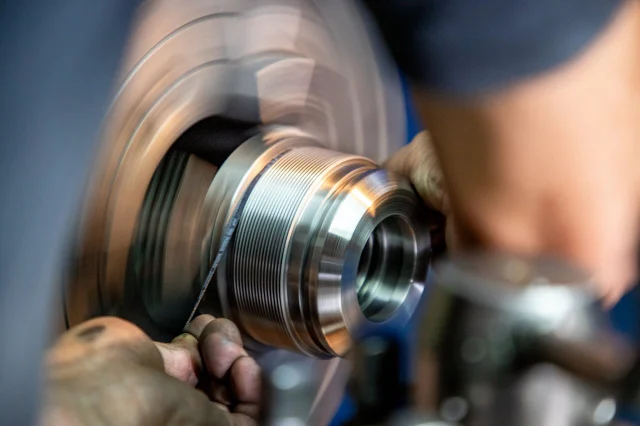
CNC turning is a precise machining process that uses computer-controlled lathes to shape rotating workpieces into cylindrical components. Ideal for creating parts with circular cross-sections, it works with a variety of materials, including metals and plastics. Known for its accuracy, efficiency, and versatility, CNC turning is widely relied upon across industries for producing both simple and complex parts.
The CNC Turning Process
The CNC turning process begins with careful setup and programming. Operators first secure the raw material—typically a cylindrical bar or rod—in the lathe chuck. The computer program, written in G-code, contains all the instructions for tool movements, cutting speeds, and feed rates.
Once the program starts, the spindle rotates the workpiece at predetermined speeds, often ranging from hundreds to thousands of revolutions per minute. The cutting tool approaches the rotating material and removes layers according to the programmed path. This systematic material removal gradually shapes the workpiece into its final form.
Tool selection plays a crucial role in the process. Different operations require specific cutting tools: turning tools for external surfaces, boring tools for internal cavities, threading tools for screw threads, and parting tools for separating finished parts from the stock material. Modern CNC lathes can automatically change tools during operation, enabling complex parts to be completed in a single setup.
The machinery itself represents decades of engineering refinement. CNC lathes feature rigid construction to minimize vibration, precise spindle systems for accurate rotation, and sophisticated control systems that monitor cutting forces and adjust parameters in real-time. Advanced models include multiple tool turrets, live tooling for milling operations, and automated part handling systems.
Quality control happens continuously throughout the process. Operators monitor dimensional accuracy using precision measuring instruments, while the CNC system tracks tool wear and automatically compensates for gradual changes in cutting tool geometry.
Applications of CNC Turning
CNC turning serves virtually every industry that requires precision cylindrical components. The automotive sector relies heavily on turned parts for engines, transmissions, and suspension systems. Components like pistons, crankshafts, and wheel hubs demand the precision that only CNC turning can consistently deliver.
Aerospace applications push CNC turning to its limits. Aircraft engines contain hundreds of turned components, from turbine shafts to fuel system fittings. The strict tolerances and material requirements in aerospace mean that CNC turning often works with exotic alloys and maintains dimensional accuracy within thousandths of an inch.
Medical device manufacturing represents another critical application area. Surgical instruments, implant components, and diagnostic equipment housings often start as CNC-turned parts. The biocompatibility requirements and sterility standards in medical applications make CNC turning’s precision and cleanliness essential.
The electronics industry uses CNC turning for connector housings, heat sinks, and component enclosures. As electronic devices become smaller and more complex, the precision of CNC turning helps create the miniaturized parts that modern technology requires.
Even traditional manufacturing sectors benefit from CNC turning. Sheet metal fabricators like those offered in Wisconsin often incorporate turned components into their assemblies, combining different manufacturing processes to create complete products.
Energy sector applications include components for oil and gas extraction, renewable energy systems, and power generation equipment. The harsh operating environments in energy applications require the material properties and precision that CNC turning provides.
Advantages of CNC Turning
The primary advantage of CNC turning lies in its exceptional precision. Modern CNC lathes routinely hold tolerances of ±0.001 inches or tighter, with some specialized machines achieving even greater accuracy. This precision remains consistent across production runs, making CNC turning ideal for parts that must fit together perfectly.
Repeatability sets CNC turning apart from manual machining methods. Once programmed, a CNC lathe can produce identical parts indefinitely, limited only by tool wear and material variations. This consistency eliminates the variability inherent in manual operations and reduces inspection requirements.
Speed and efficiency make CNC turning economically attractive. Automated tool changes, rapid positioning systems, and optimized cutting parameters allow CNC lathes to complete parts faster than traditional methods. The ability to run unattended during lights-out operations further improves productivity.
Material utilization efficiency reduces waste and costs. CNC turning’s precise control over material removal minimizes scrap and maximizes the number of parts produced from each piece of stock material. The predictable cutting process also reduces the risk of scrapping expensive materials due to machining errors.
Flexibility represents another significant advantage. CNC turning can handle everything from prototype quantities to high-volume production runs. Program changes allow quick adaptation to design modifications without retooling, making CNC turning suitable for both custom and standard parts.
Complex geometries become achievable through CNC turning’s multi-axis capabilities. Modern machines can create intricate profiles, multiple diameters, and precise features like grooves and threads in a single setup. This capability reduces handling time and improves dimensional relationships between features.
Surface finish quality often exceeds what other machining methods can achieve. The controlled cutting action and stable setup conditions in CNC turning produce smooth, consistent surface finishes that may eliminate secondary operations like grinding or polishing.
Conclusion
CNC turning is advancing with technologies like AI, sensors, and automation, making it essential for precise and efficient manufacturing across industries. It caters to diverse needs, from small electronic components to large machinery parts, delivering accuracy and consistency.